Carrying a soft prompt from one model to another
Say you’ve spent real effort tuning a soft prompt — a little set of learned vectors that makes a model good at some task. Then a newer, better model comes out. Can you just hand your prompt over to the new model?
With a text prompt, sure — words are words, and you can paste them anywhere. But a continuous (soft) prompt isn’t words. It’s a bundle of raw embedding vectors tuned to one specific model’s internal space. Hand those numbers to a different model and they mean nothing. The effort doesn’t transfer.
That portability gap is what zero-shot continuous prompt transfer (Wu et al., 2024) sets out to close.
Why soft prompts don’t travel
Every model carries its own private map of meaning. Two models might both “understand” language, but the coordinates they use are completely different — the direction that means “about sports” in one model points somewhere unrelated in another.
A soft prompt is just a point (well, a few points) on one model’s map. Copy those exact coordinates onto a different map and you land somewhere arbitrary. The prompt was never a statement about the task in the abstract; it was a statement in one model’s private dialect.
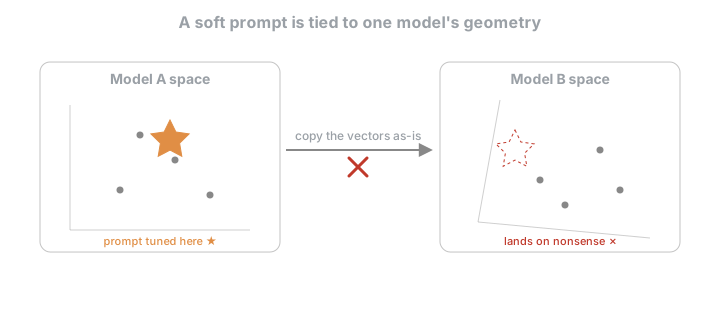
The same coordinates mean different things on different maps, so a direct copy fails.
The idea: describe a prompt by what it’s near
The fix is to stop describing the prompt by its absolute coordinates and start describing it by its relationships. Pick a set of ordinary words that both models know — “river,” “happy,” “run,” and so on — and use them as anchors. Then describe the source prompt not as “these vectors,” but as “this much like river, this much like happy, this much like run…”
That description — a list of similarities to shared anchor words — is the relative representation. And crucially, it’s model-agnostic: because both models know the same anchor words, both can speak in this common language. It captures the task semantics of the prompt while throwing away the model-specific coordinate frame.
To transfer, you flip the process around on the target model: search for a prompt in the new model whose relationships to those same anchors match the source’s. No labeled data, no retuning on the target — just find the point on the new map that has the same description.
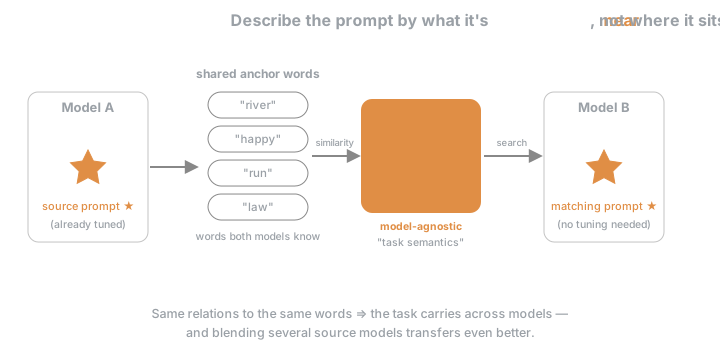
Encode the prompt as relations to shared words, then find the prompt in the new model with the same relations.
Does it actually work?
It does. Prompts transferred this way carry their task ability across to other models without any tuning on the target side — confirming that the “task semantics” baked into a continuous prompt really are generalizable, not just an artifact of one model.
There’s also a nice bonus. If you encode the same task from several source models and combine their relative representations, the transfer gets even better. Pooling several models’ takes on a task washes out each one’s idiosyncrasies and leaves a cleaner signal of what the task actually is.
Why I think this matters
Soft prompts are cheap to store but, until now, awkwardly disposable — retire a model and the prompts you tuned for it retire with it. Treating a prompt’s meaning as a set of relationships rather than fixed coordinates makes that knowledge portable: you can move task know-how onto new and better models as they arrive, instead of starting over each time.
The broader idea I like here is the reframing — meaning as relations, not coordinates. A point is only interpretable relative to a shared frame of reference, and once you choose anchors everyone agrees on, a surprising amount of “model-specific” stuff turns out to be translatable after all.
The full method, the relative-space encoding, and the experiments are in the paper.
References
2024
- ICLR
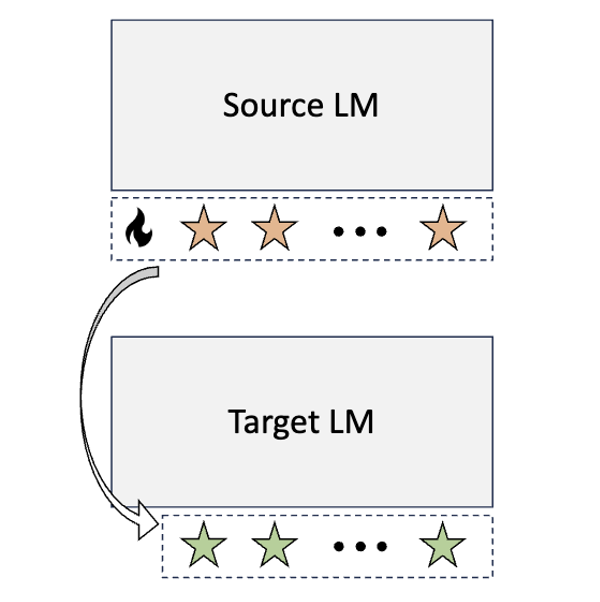 Zero-Shot Continuous Prompt Transfer: Generalizing Task Semantics Across Language ModelsIn International Conference on Learning Representations , 2024
